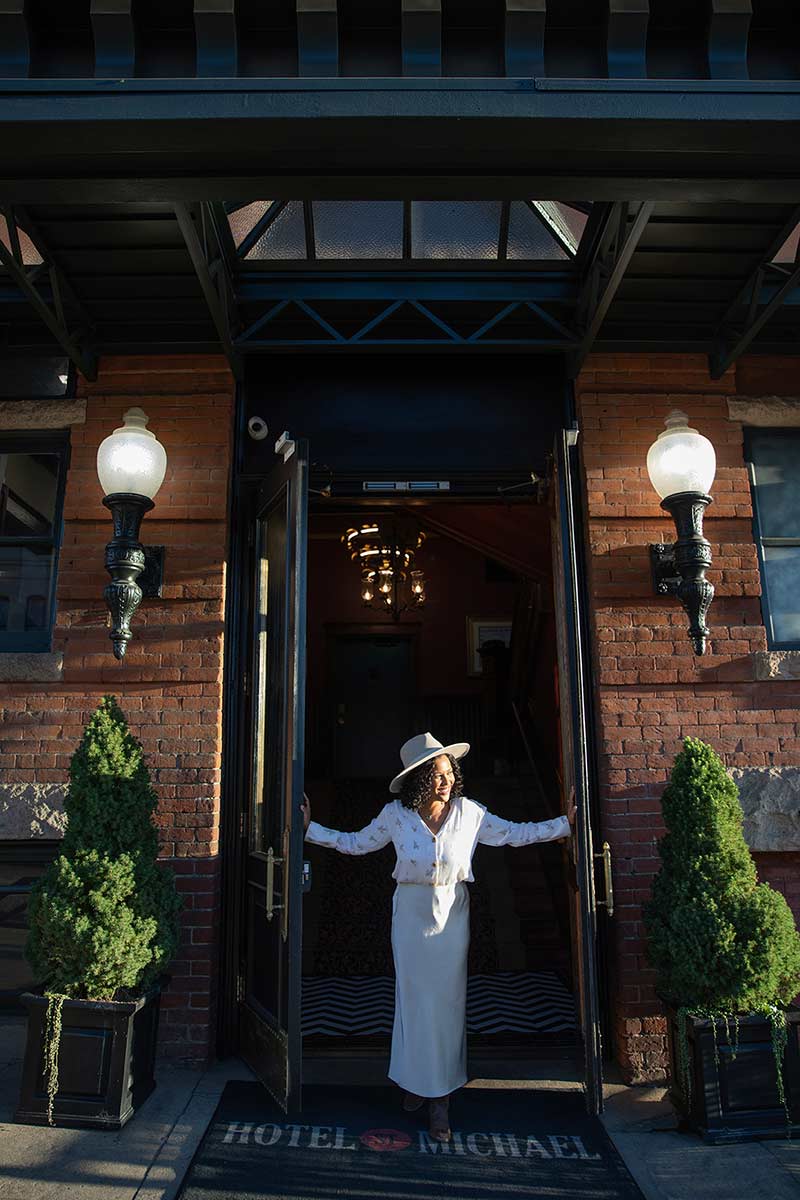
Hotel St. Michael and the Story of Whiskey Row
Pre-1860s
Before Prescott had a name, this land belonged to the Yavapai—the People of the Sun. Life followed daylight and season. Families moved between granite dells, pine forests, and higher country as resources shifted. Survival depended on movement, not ownership.
 Photo placeholder · 1
1863
In 1863, gold was found in the Bradshaw Mountains. Prospectors arrived quickly. Camps followed—most temporary, here one season, gone the next—tied to whatever the ground was willing to give.
 Photo placeholder · 2
1864
Prescott was different by design. Gold had already taken hold in the surrounding hills, but in 1864, during the Civil War, President Abraham Lincoln appointed John Noble Goodwin to establish a territorial capital for Arizona. The town was set apart from the mines—meant to govern, supply, and anchor the territory. The courthouse plaza stood at its center.
 Photo placeholder · 3
1867
Miners worked the surrounding hills while prospectors, ranchers, politicians, lawmen, and outlaws moved through town. Saloons lined the street facing the plaza. By the late 1860s, Whiskey Row had taken shape— more than forty saloons crowded a few blocks. Work was found here, deals were struck, disputes settled. News moved fast.
 Photo placeholder · 4
Faro ran the Row—cards turning fast, gold dust laid down, fortunes made and lost on the flip.
Before the railroad, nearly everything came by riverboat up the Colorado, then by stagecoach and wagon across desert and mountain. Roads washed out. Passes closed. Deliveries were slow and costly. Whiskey, champagne, oysters—they all made the trip.
When the Peavine Railroad reached Prescott in 1887, it came slowly—hard-won over the mountains. And when it arrived, it changed everything.
As the Row grew, it became clear the street could not run on spectacle alone. Just out of view on Granite Street, another side of town took shape— Chinese Alley, later Whiskey Alley. Licensed brothels, laundries, gardens, and service routes supported the saloons out front. Not hidden—necessary. The working side of the Row.
 Photo placeholder · 5
1868
In 1868, The Diana Saloon opened on the corner of Gurley and Montezuma, described at the time as a “magnificent edifice.” Fine food, imported spirits, high-stakes gambling.
By the late 1870s, Doc Holliday and the Earp brothers were known in Prescott—before the legends, before Tombstone. In 1877, Virgil Earp took part in a pursuit that ended in a deadly shootout. Soon after, he was appointed Deputy U.S. Marshal.
 Photo placeholder · 6
1891
In 1891, the Hotel Burke opened on the same corner, promoted as “the only fire-proof hotel in Arizona.” Built of brick, it stood apart on Whiskey Row—a mansard roof, dormer windows, and a corner turret giving it a presence more Eastern than frontier. Inside, an elegant lobby and “single and en suite” rooms were ahead of their time.
 Photo placeholder · 7
1900
In 1900, the Great Fire swept down Whiskey Row and proved otherwise. Nearly everything was lost. Only two arches of the Burke remained.
 Photo placeholder · 8
1901
In 1901, the Hotel Burke reopened and was soon renamed Hotel St. Michael—named for the archangel of protection—the defender against evil. Three stories of stone in the Second Renaissance Revival style. It became a defining landmark on Whiskey Row—part hotel, part gathering place, part anchor at the edge of the plaza.
In 1925, Prescott’s first elevator was introduced. It remains in operation today.
 Photo placeholder · 9
1915
When Arizona went dry in 1915, Whiskey Row did not stop—it adjusted. Upstairs stayed within the law. Downstairs moved quietly.
At Hotel St. Michael, a speakeasy operated in the cellar. If you knew where to look, entry was simple: a street-front candy store, stairs just out of sight, and a bar below.
That speakeasy, now called Fire & Sword, remains open today—underground but hidden.
When Prohibition ended in 1933, drinking returned to the open. The bars came back into view, and Whiskey Row settled into patterns that had never fully disappeared.
 Photo placeholder · 10
 Photo placeholder · 11
2026
Today, Hotel St. Michael still holds its place at the edge of the plaza, opening onto Whiskey Row—where governance, commerce, risk, and reward met every day and shaped the town around them.
 Photo placeholder · 12